
Most big companies think of waiting lines as something boring that just happens in the background. They only pay attention to them when something goes wrong. However, the best companies treat these lines as a way to get ahead. They don’t just watch the lines; they try out new ideas to see what works best. This is called A/B testing, where they compare two different ways of doing things to see which one is faster and keeps customers happier.
Smart companies look at the best way to move people through a store or a website. Using data to solve queuing problems is much better than just guessing. When a company knows exactly how to manage its lines, it can save a lot of money and help its workers get more done. It also makes the brand look much better to the public. These big businesses are turning a simple task into a powerful tool. This helps them beat their competitors and keep their customers happy for a long time.
Why A/B Testing for Queue Management is a Strategic Enterprise Priority in 2026
Queue optimization strategies have moved out of IT roadmaps and into boardrooms. Decision-makers now recognize that customer flow directly impacts revenue, retention, and reputation at scale.
From “Managing Lines” to Orchestrating Enterprise Experiences
- Queues are brand moments, not operational nuisances. Every second a customer waits forms an impression, positive or negative, about your organization’s competence and care.
- Wait time impacts revenue, loyalty, and trust. Research consistently shows that perceived fairness and predictability matter more than absolute wait time. Get the experience wrong, and customers leave, or worse, they stay but never return.
- The shift from frontline optimization to board-level accountability. CXOs are now measured on experience consistency across hundreds of locations. Queue performance is no longer a regional manager’s problem.
The Hidden Cost of Poor Queue Experiences at Enterprise Scale
- Revenue leakage from abandoned visits. In banking, healthcare, and retail, walkaways represent lost transactions, missed appointments, and unrecovered service opportunities. One major retailer calculated 8% revenue loss annually from queue abandonment alone.
- Employee burnout and service inconsistency. Frontline staff managing chaotic, unpredictable queues deliver inconsistent service. High-performing employees leave. Training costs skyrocket.
- CX fragmentation across regions and channels. Without standardized queue analytics software, enterprises can’t compare performance between branches, identify best practices, or replicate success at scale.
In sectors like healthcare, where queue failures translate directly into missed appointments and operational strain, the cost of unmanaged wait times becomes impossible to ignore, as seen in:
how hospitals struggle with long queues and why data-driven queue technology is now essential
2026 Enterprise Reality: Why Legacy Systems Are Breaking Down
- Inflexible hardware-based systems can’t adapt. Fixed kiosks and static signage can’t respond to real-time demand shifts, seasonal spikes, or sudden service disruptions.
- Inability to handle demand spikes without chaos. Black Friday, tax season, vaccine drives, legacy systems collapse exactly when the stakes are highest.
- Poor visibility for leadership means reactive firefighting. Without real-time queue performance metrics, executives learn about problems from social media complaints, not dashboards.
What Enterprise Leaders Actually Expect in 2026
- One platform, not disconnected tools. Integration fatigue is real. Leaders want unified customer journey optimization across physical, virtual, appointment, and self-service channels.
- Predictability over reaction. A/B testing for queue management allows enterprises to model changes before rolling them out globally, reducing risk and accelerating improvement cycles.
- Measurable outcomes tied to CX, Ops, and Growth. No more “we think it’s working.” Modern queue management analytics deliver attribution: this change reduced wait time by X, improved NPS by Y, and increased throughput by Z.
What Makes Queue Optimization Strategies Testable and Scalable
Not all queue management experiments deliver insights worth acting on. The difference lies in how experiments are designed, measured, and operationalized across the enterprise.
Evaluation Framework: Metrics That Matter to CXOs and Boards
- Wait time reduction vs throughput optimization. Reducing average wait time sounds good until you realize throughput dropped. Smart queue optimization balances both, serving more customers faster without sacrificing quality.
- Service equity and experience consistency. A/B testing reveals whether certain customer segments face longer waits, unequal treatment, or inconsistent service, issues that can escalate into compliance risks.
- Executive dashboards and decision-ready reporting. Raw data doesn’t drive decisions. Effective queue analytics software translates experiments into clear before/after comparisons that justify budget and headcount decisions.
Designing High-Impact Queue Management Experiments
- Start with the hypothesis, not the feature. “Will offering virtual queue options reduce physical crowding?” is testable. “Let’s add a mobile app” is not.
- Control for variables that distort results. Time of day, day of week, staff availability, and seasonal trends all impact queue performance metrics. Poor experimental design leads to false conclusions.
- Run tests long enough to capture patterns, not outliers. One week isn’t enough. Enterprises need statistically significant sample sizes across multiple weeks to account for variability.
Key Experiment Categories Worth Testing
- Arrival orchestration: Does appointment scheduling reduce peak congestion better than walk-in optimization?
- Queue routing logic: Should high-value customers get priority lanes, or does fairness matter more to overall satisfaction?
- Communication frequency: Do real-time wait updates reduce abandonment, or do they increase anxiety?
- Self-service adoption: Which kiosk placement, messaging, and UX design drives the highest usage rates?
Technology Requirements for Effective A/B Testing
- Real-time data capture across all touchpoints. Virtual queue management, self-service kiosks, staff terminals, and appointment systems must feed into one analytics layer.
- Segmentation and cohort analysis capabilities. Testing “all customers” reveals little. Smart enterprises test by customer type, service complexity, location, and time window.
- Integration with operational systems. Queue experiments that can’t link to staffing schedules, inventory data, or CRM insights miss half the story.
High-Impact Experiments: What Enterprise Leaders Are Testing
The most sophisticated organizations aren’t guessing. They’re running structured customer flow A/B testing to systematically improve operations, experience, and outcomes.
Experiment 1: Virtual Queue vs Physical Queue Entry Points
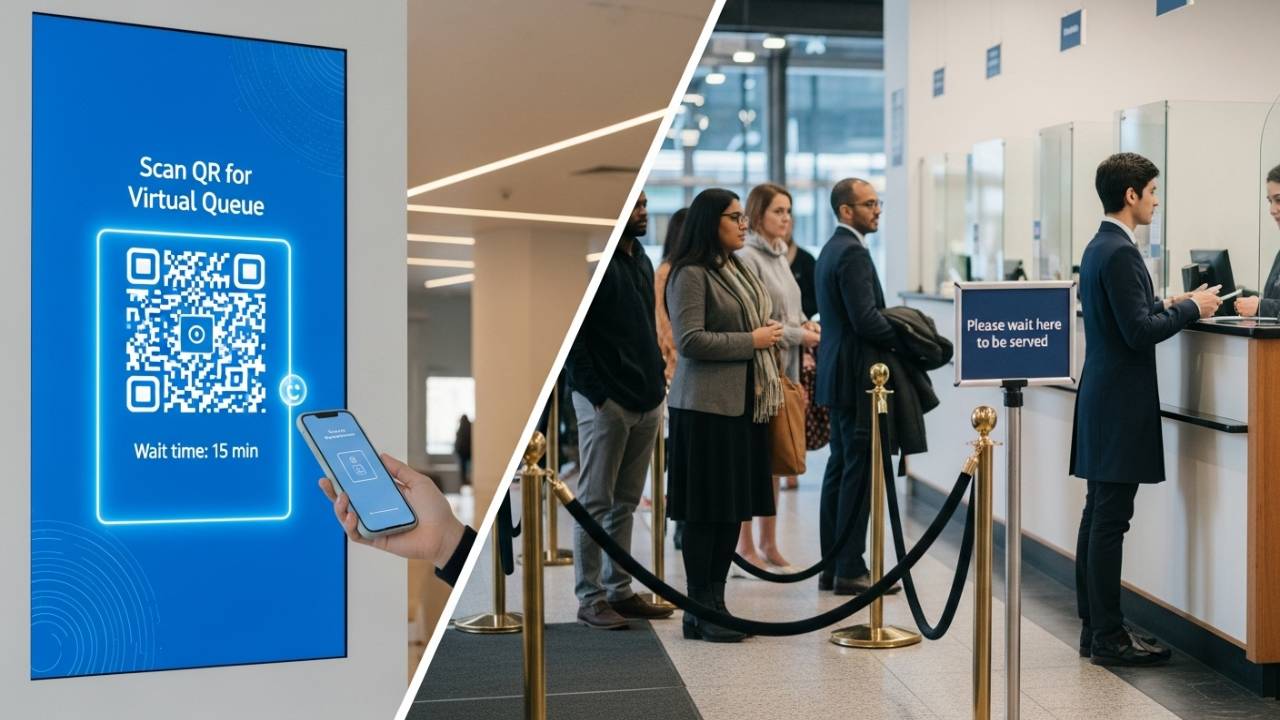
- The question: Does offering virtual queue options reduce physical crowding and improve customer satisfaction?
- Test design: Half of the locations offer mobile check-in; half remain walk-in only. Measure wait time, abandonment, NPS, and staff utilization.
- Findings that matter: Virtual queues reduce peak congestion but require customer education. Success depends on signage clarity, mobile UX, and staff readiness to serve virtual arrivals seamlessly.
This comparison builds on the fundamental differences between digital and traditional waiting models, explored in detail in our guide on virtual queues vs token-based systems, where customer flexibility, visibility, and perceived control play a decisive role.
Experiment 2: Transparent Wait Time Communication
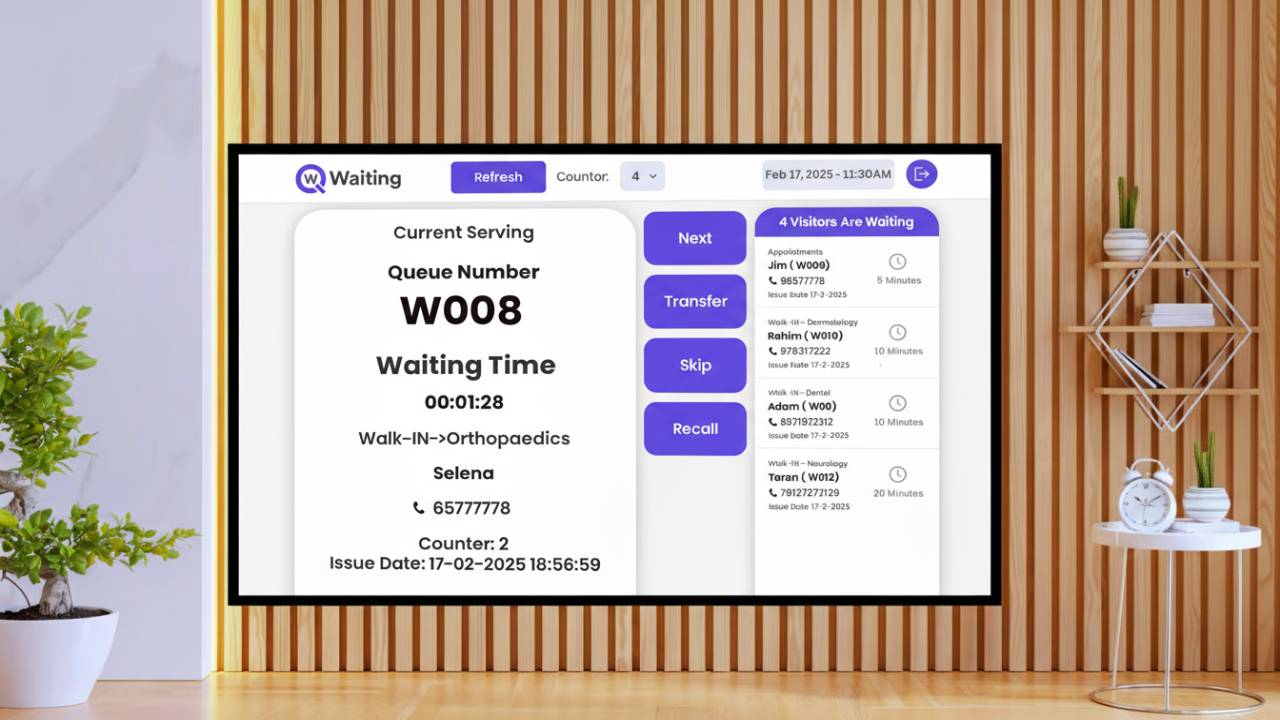
- The question: Does displaying estimated wait times increase or decrease queue abandonment?
- Test design: Show real-time estimates in some locations, generic “please wait” messaging in others. Track walk-aways, complaints, and post-service satisfaction.
- Findings that matter: Transparency reduces abandonment when wait times are reasonable (<15 min), but increases it when waits are long. The insight: fix capacity problems before improving communication.
Experiment 3: Service Lane Optimization
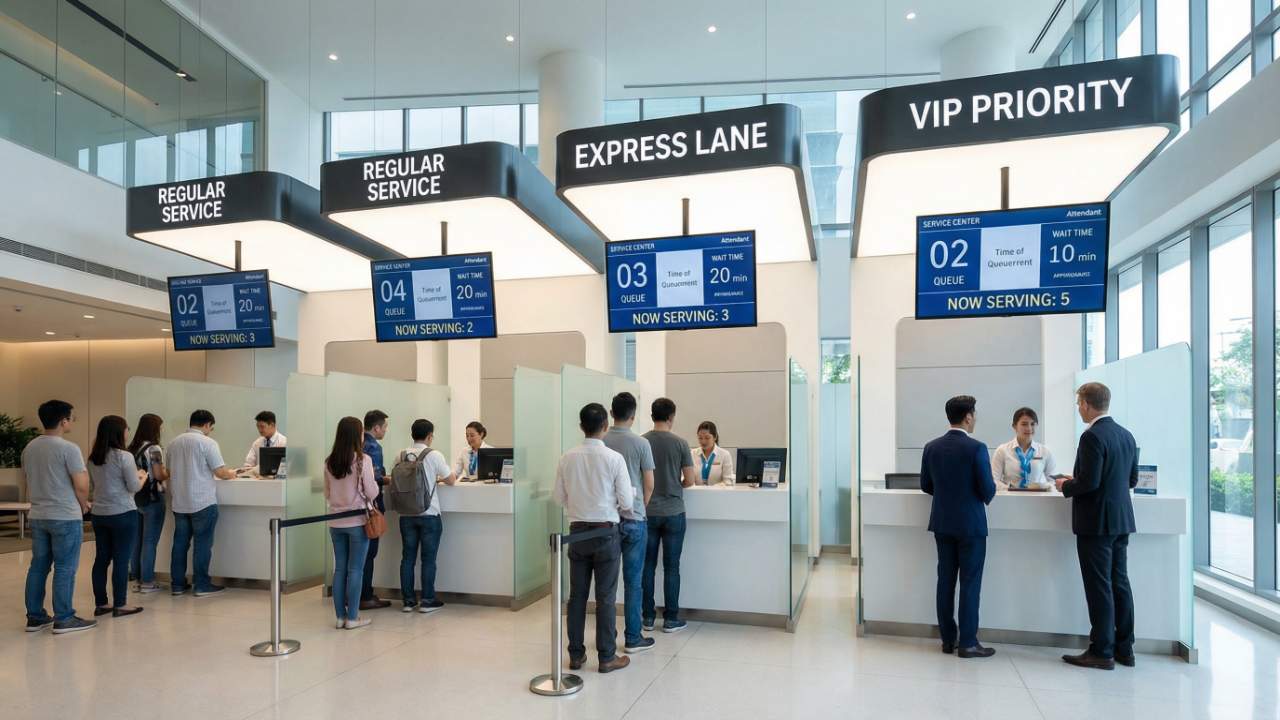
- The question: Should enterprises create express lanes, specialist lanes, or universal service lanes?
- Test design: Compare throughput, wait time, and customer satisfaction across different lane configurations in matched locations.
- Findings that matter: Express lanes improve throughput but can create fairness concerns. Success requires clear eligibility criteria and visible queue performance metrics to prevent staff discretion from undermining trust.
Experiment 4: Appointment Scheduling vs Walk-In Optimization
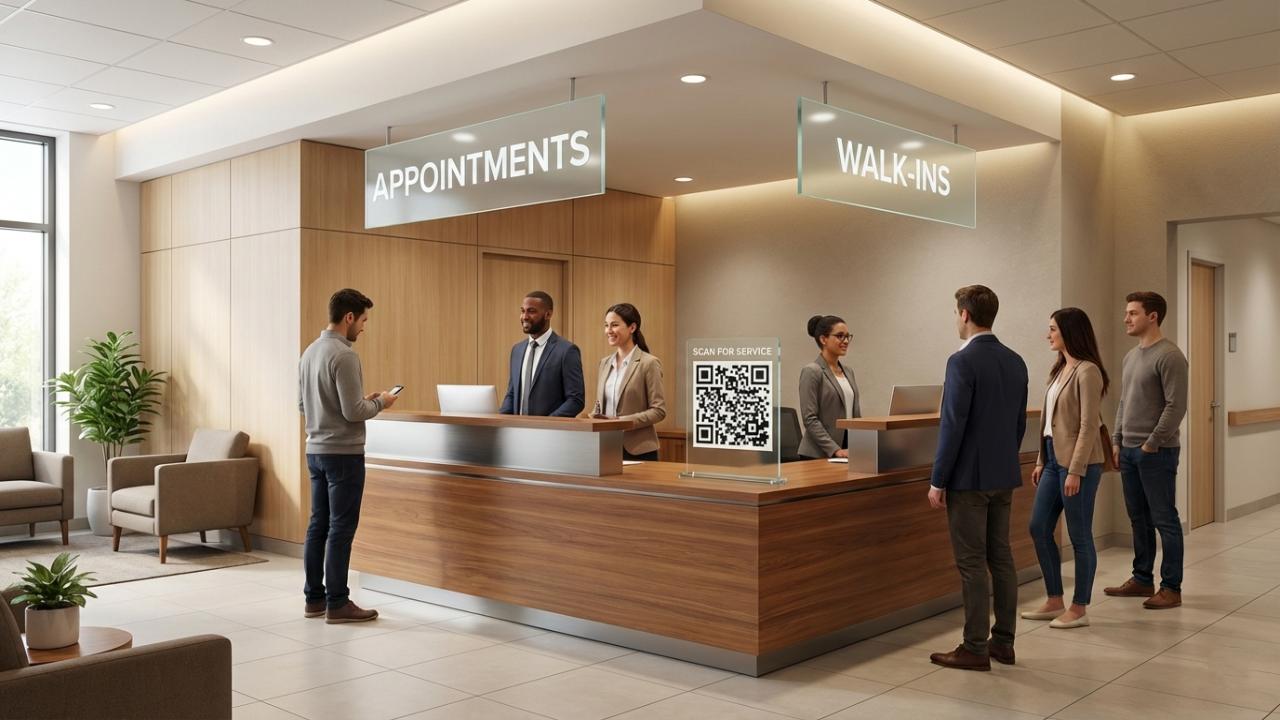
- The question: Is it better to maximize appointment bookings or improve walk-in queue efficiency?
- Test design: Push appointments heavily in some markets, optimize walk-in flow in others. Measure total customer volume, no-show rates, and resource utilization.
- Findings that matter: Appointments reduce uncertainty for staff but introduce no-show risk. Walk-in optimization increases volume but requires staffing flexibility. The best systems offer both and test how to balance them.
Experiment 5: Self-Service Kiosk Placement and Messaging
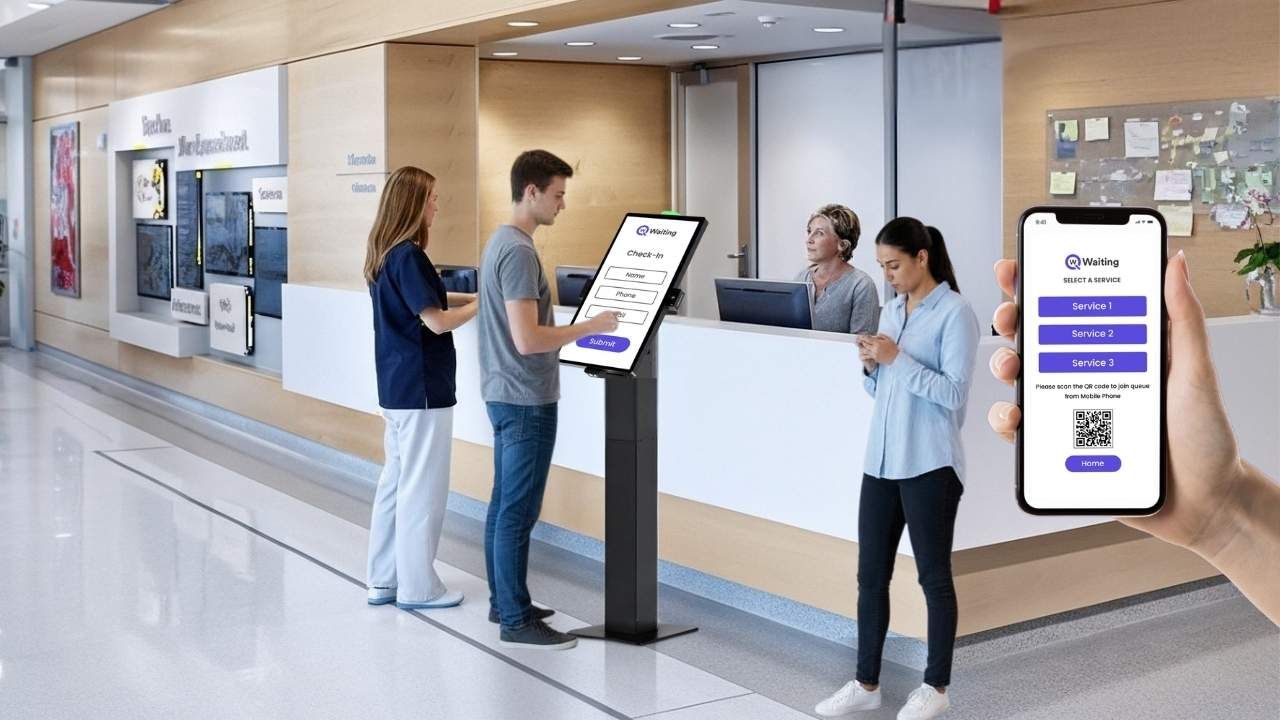
- The question: Where should kiosks be placed, and what messaging drives adoption?
- Test design: Test lobby placement vs entrance placement. Test “skip the line” messaging vs “check in here” messaging.
- Findings that matter: Kiosk adoption depends more on perceived ease than placement. Customers avoid self-service when they fear making mistakes. Success requires intuitive design and visible staff support nearby.
Common A/B Testing Mistakes That Waste Time and Budget
Even sophisticated enterprises make avoidable mistakes when testing queue management strategies. Knowing what not to do is as important as knowing what works.
Testing Too Many Variables at Once
- The mistake: Changing queue routing, communication, staffing, and kiosk placement simultaneously, then trying to attribute results.
- Why it fails: You’ll never know which change drove the outcome. Correlation becomes impossible to separate from causation.
- The fix: Isolate variables. Test one major change at a time. Use control groups. Accept that rigorous testing takes patience.
Ignoring Operational Readiness
- The mistake: Rolling out virtual queue A/B testing without training staff to handle mobile check-ins, or testing self-service kiosks in locations with no IT support.
- Why it fails: Technology changes fail when frontline teams can’t support them. Customers blame the brand, not the test design.
- The fix: Pilot with operationally mature locations first. Build training and support infrastructure before scaling experiments.
Measuring Vanity Metrics Instead of Business Impact
- The mistake: Celebrating “10% reduction in average wait time” without checking whether throughput, satisfaction, or revenue improved.
- Why it fails: Averages can be misleading. Wait time might drop because customers abandoned the queue, not because service improved.
- The fix: Always pair efficiency metrics with experience and outcome metrics. If one improves while others decline, the experiment fails.
Stopping Tests Too Early
- The mistake: Running a two-week test and declaring victory, ignoring seasonal effects, staffing changes, and sample size requirements.
- Why it fails: Short tests capture noise, not signal. One holiday, one flu outbreak, one unusually busy Tuesday—and your conclusions are worthless.
- The fix: Commit to minimum test durations (4-8 weeks). Use statistical significance thresholds. Accept that good data takes time.
Not Closing the Loop with Frontline Teams
- The mistake: Headquarters runs experiments, analyzes data, and rolls out changes without consulting the staff who interact with customers daily.
- Why it fails: Frontline teams see patterns that data misses. They know why certain queues move slowly, why customers avoid kiosks, and why specific times are chaotic.
- The fix: Involve branch managers and frontline staff in experiment design. Debrief after every test. Incorporate qualitative insights with quantitative data.
Many of these disconnects stem from avoidable operational blind spots. A broader breakdown of recurring pitfalls and practical corrections is covered in our guide on:
Technology Infrastructure: What Enterprises Need to Test Effectively
A/B testing for queue management requires more than good intentions. It requires architecture, integration, and analytic maturity that many legacy systems simply can’t provide.
Real-Time Data Collection Across All Channels
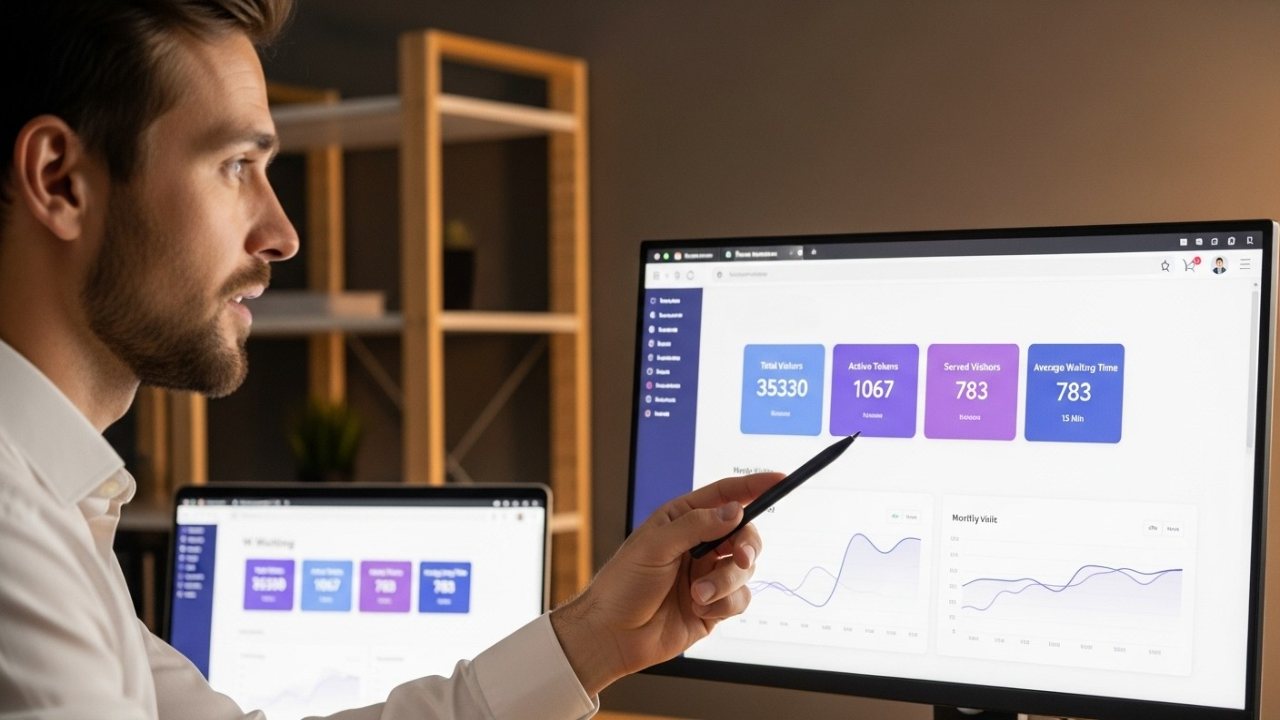
- Queue management systems must capture every customer interaction, physical check-ins, mobile queues, kiosk usage, appointment bookings, and staff terminal activity.
- Without unified data, experiments compare apples to oranges. Enterprises end up with blind spots that undermine test validity.
Flexible Segmentation and Cohort Analysis
- Effective testing requires the ability to compare locations, customer types, service categories, time windows, and staff teams.
- Queue analytics software that only reports system-wide averages hides the variance that drives insights.
Integration with CRM, Scheduling, and Operational Systems
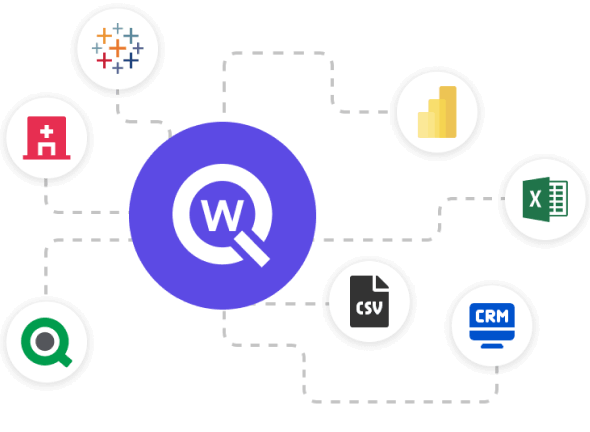
- The most valuable queue experiments connect wait time to customer value, service complexity to staffing needs, and satisfaction to long-term behavior.
- Traditional systems make this impossible. Modern queue management analytics must pull data from, and push insights to, the broader enterprise tech stack.
Cloud-Based Deployment for Consistent Testing

- Enterprises with on-prem, hardware-dependent queue systems struggle to deploy experiments consistently across locations.
- Cloud infrastructure allows centralized test design, real-time monitoring, and instant rollback if experiments fail.
This limitation of legacy deployments is explored further in our comparison of cloud-based vs on-premise queue management systems, outlining why flexibility and speed now matter more than fixed infrastructure.
API Depth for Custom Experiment Design
- Off-the-shelf A/B testing features cover common use cases but can’t anticipate every enterprise-specific hypothesis.
- API access allows data science teams to design custom experiments, apply advanced statistical methods, and integrate proprietary analytics.
The Future of Queue Optimization: What’s Next
The most forward-thinking enterprises aren’t just testing today’s queue strategies. They’re preparing for a future where queues become predictive, personalized, and nearly invisible.
Predictive Queue Management
- AI-powered systems will forecast demand hours or days in advance, allowing proactive staffing adjustments and customer communication.
- A/B testing will shift from “what works” to “what works when”—optimizing strategies dynamically based on predicted conditions.
Personalized Journey Routing
- Queue systems will route customers based on value, need, and preference—not just arrival time.
- Testing will focus on fairness algorithms, ensuring personalization doesn’t create new inequities.
This evolution toward intentional journey design is rooted in how customer flow shapes perception and satisfaction, explored in depth in our guide on:
Proactive Service Invitations
- Instead of customers joining queues, systems will invite them to service windows at optimal times—balancing demand, capacity, and individual preferences.
- Experiments will measure how proactive communication affects no-shows, satisfaction, and throughput.
Experience Automation at Scale
- The queue of tomorrow isn’t managed—it’s orchestrated. Customers move through journeys so smoothly they barely notice the wait.
- The enterprises that master A/B testing today will lead this transformation. The ones that don’t will struggle to catch up.
Final Thought: Why Testing Matters More Than Technology
Every enterprise has queues. Not every enterprise improves them. The difference isn’t budget, technology, or industry—it’s mindset. Organizations that treat queue management as infrastructure invest once and hope. Organizations that treat it as a testable, improvable system compound advantages over time. They reduce wait times while competitors guess. They allocate resources based on data, while others rely on instinct. They create experiences customers remember, while others create friction customers avoid.
Book your 14-day free trial with Qwaiting today and transform your A/B testing for queue management progress.